
· Updated · Jiří Škapa · VORTARIAN · 2 min read
VORTARIAN 4R2T-10G: Tested 10 GbE Network Cards, Switches and SFP+ Modules
Network cards, switches, SFP+ modules and cables tested with the VORTARIAN 4R2T-10G in long-term streaming runs without UDP packet loss.
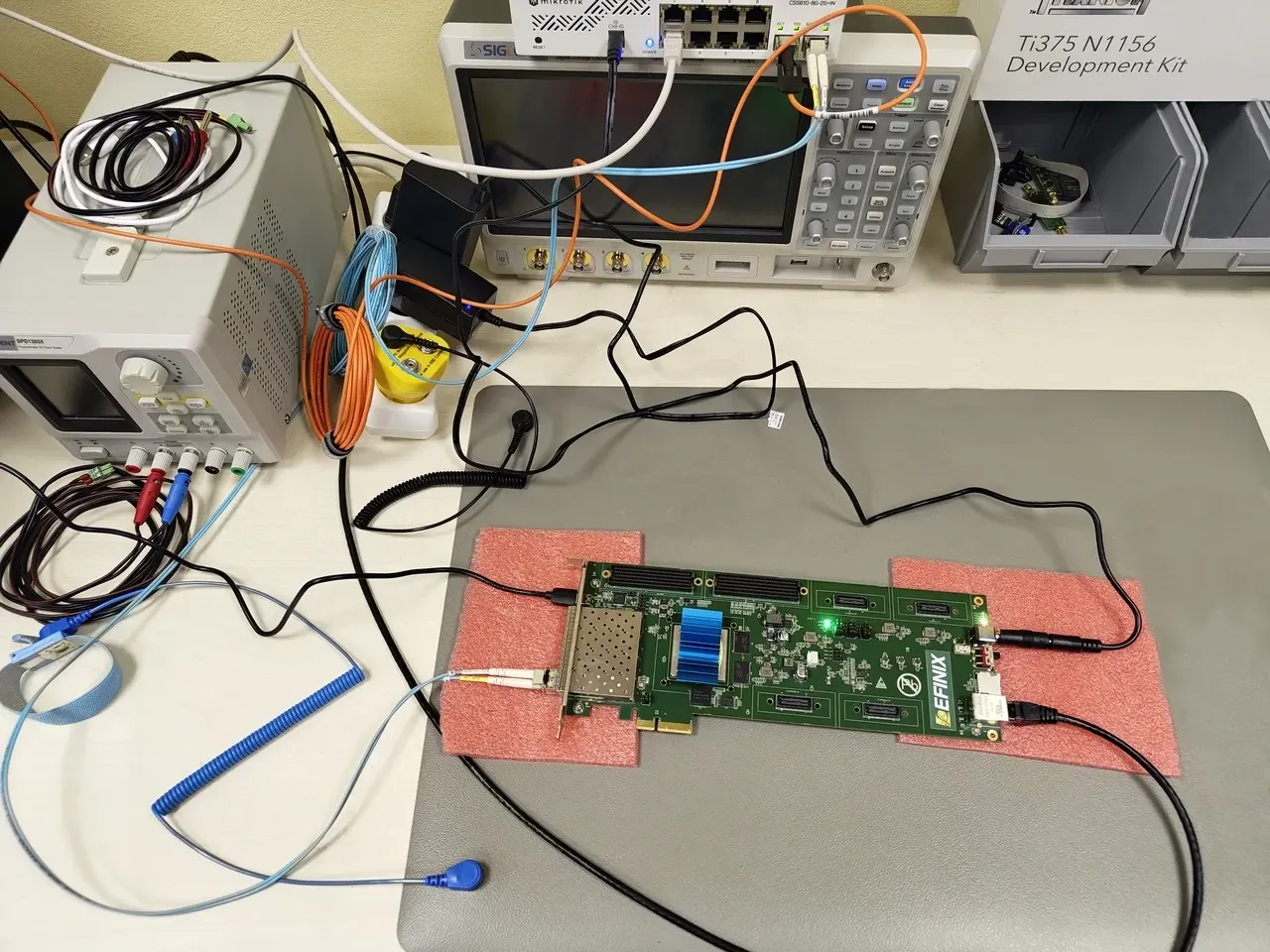
The VORTARIAN 4R2T-10G streams I/Q data over two 10GBASE-SR links, FO1 and FO2. The UDP sender in the FPGA can load each link up to the full 10 Gb/s line rate. The hardware below was tested in long-term transfer runs on the VORTARIAN board and on the Efinix Titanium Ti375 N1156 Development Kit, running the same 10 GbE UDP firmware. No UDP packet loss and no problems with link establishment or stability were detected.
Network cards
| Card | Ports |
|---|---|
| Mellanox ConnectX-5 MCX512F-ACHT (HPE P13186-001) | 2× SFP28, 10/25 GbE |
| Mellanox ConnectX-4 Lx MCX4121A-ACUT (HPE 840140-001) | 2× SFP28, 10/25 GbE |
| Intel X520-DA2 (82599ES), 10Gtek | 2× SFP+, 10 GbE |
| Intel 82599ES, unbranded X520-DA2 compatible card | 2× SFP+, 10 GbE |
| Broadcom NetXtreme II BCM57810S, 10Gtek | 2× SFP+, 10 GbE |
| Marvell AQtion AQC100, ASUS XG-C100F | 1× SFP+, 10 GbE |
With a dual-port card, one card receives both links. With the single-port Marvell card, one card receives one link, that is two of the four channels.
PCIe slot
With all four channels on, both links together carry about 16 Gb/s, and a dual-port card has to move all of it over PCIe. Some cards in the list, such as the Intel 82599ES and the Broadcom BCM57810S, are PCIe 2.0 devices. A PCIe 2.0 lane carries 4 Gb/s of data, so four lanes give at most 16 Gb/s before protocol overhead, which is not enough for both links. Such a card needs a slot with at least 8 connected PCIe lanes (PCIe 2.0 x8 or faster). In an x4 slot it drops part of the data, roughly a fifth with both links at full rate, although the board sends every packet.
Many motherboards have slots that are mechanically x16 but have only four lanes wired. Check the electrical width in the motherboard manual, or on Linux in the LnkSta line of sudo lspci -vv for the card (the capabilities need root), which must show Width x8. PCIe 3.0 cards such as the ConnectX-4 Lx and ConnectX-5 have enough bandwidth for both links in an x4 slot.
Switches
| Switch | Ports |
|---|---|
| MikroTik CSS610-8G-2S+IN | 8× 1 GbE RJ45, 2× 10 GbE SFP+ |
| Arista DCS-7050S-52-R | 48× 10 GbE SFP+, 4× 40 GbE QSFP+ |
SFP+ modules and cables
Optical modules, 10GBASE-SR, 850 nm, multimode:
- Intel AFBR-710DMZ-IN1
- TP-Link TL-SM5110-SR
- 10Gtek 10GBASE-SR
- FS 10GBASE-SR
Active optical cables: FS 10G SFP+ AOC, 5 m and 15 m.
Direct-attach copper: 10Gtek CAB-10SFP-P2M, 2 m passive, AWG30.
Other hardware with 10GBASE-SR or SFP+ is likely to work as well; the list above is what we have tested. The ports of the board are described in VORTARIAN 4R2T-10G Board Ports.
Written by
Jiří Škapa · Lead RF/FPGA engineer at JSE
Jiří has designed RF and signal-processing hardware and FPGA firmware since 2003, starting with receivers and signal-processing boards for radar systems. He holds a master's degree in radio engineering from the Czech Technical University in Prague.