
· Updated · Jiří Škapa
Introducing VORTARIAN 4R2C-2G5: 2.4 GHz RF Mezzanine Front End
A four-receive, two-transmit RF mezzanine for the 2.4 GHz ISM band, with more than 100 MHz instantaneous bandwidth, an on-board 100 MHz OCXO and an integrated phase-calibration path.
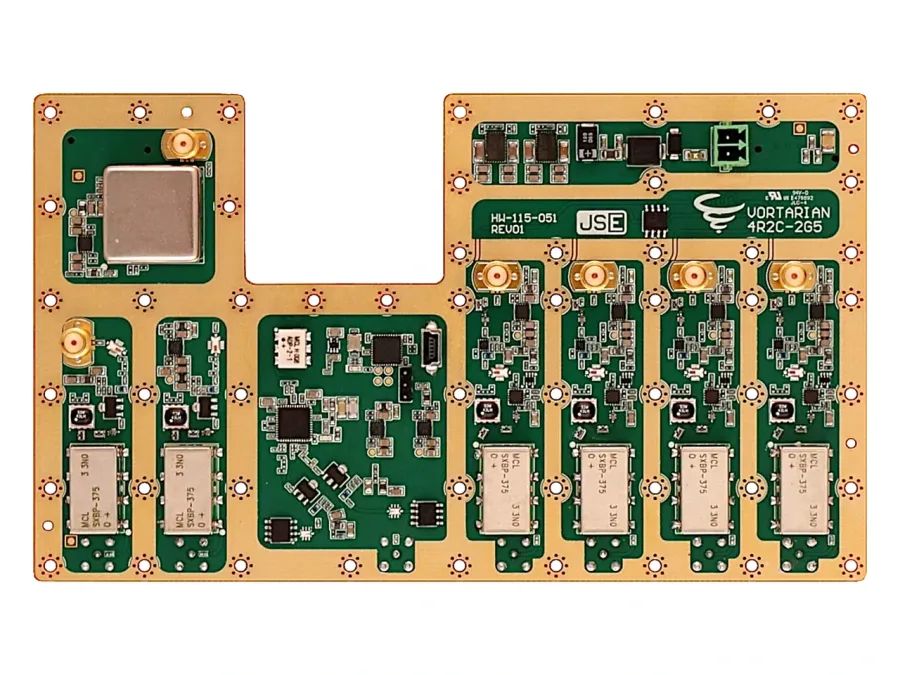
The VORTARIAN 4R2C-2G5 is the first RF mezzanine front end for the VORTARIAN 4R2T-10G platform and the reference implementation for the 2.4 GHz ISM band.
The base board samples directly from 20 MHz to 1.4 GHz. Above that range, a mezzanine mounted on top of the base board converts the application band into the base board’s native range. The 4R2C-2G5 does this for 2.4 GHz.
Key parameters
| Parameter | Value |
|---|---|
| Frequency band | 2.4 GHz ISM |
| Instantaneous RF bandwidth | more than 100 MHz |
| Receive paths | 4, phase-coherent |
| Transmit paths | 2, one dedicated to multi-channel phase calibration |
| RF interface | 50 Ω, SMA |
| RX gain modes | low gain and high gain, selectable |
| RX noise figure | 2.7 dB typical, high gain (simulated) |
| RX sensitivity | about −111 dBm at 1 MHz bandwidth and 0 dB SNR (simulated) |
| Frequency reference | on-board 100 MHz low-phase-noise OCXO, ±50 ppb |
Applications
- Direction finding and angle of arrival of 2.4 GHz emitters, such as drone control and video links, Wi-Fi and Bluetooth devices.
- Short-range passive radar research using Wi-Fi access points as illuminators.
- Antenna array and beamforming development, with a four-element coherent receiver and built-in phase calibration.
Receive paths
The four receive paths share one frequency reference, so the phase relationship between channels is preserved through the conversion. This is what direction finding, beamforming and multi-channel radar need: the phase difference between channels is the measurement.
The low-gain mode handles strong signals without overloading the chain. The high-gain mode gives the lowest noise figure for weak signals.
Transmit paths and phase calibration
One of the two transmit paths is dedicated to multi-channel phase calibration. It is used to measure and correct the phase differences between the receive channels.
Frequency reference
The mezzanine carries a low-phase-noise 100 MHz OCXO with ±50 ppb stability. The clock performance of the base board is described in Measuring Phase Noise in SDR Systems.
Other bands
The base board does not change between mezzanines. A mezzanine for another band, including microwave and mmWave bands up to 75 GHz, uses the same converters, clocking, FPGA and 10 GbE links. The base board is described in Introducing VORTARIAN and VORTARIAN 4R2T-10G Board Ports.
Full specifications are in the VORTARIAN 4R2T-10G datasheet and on vortarian.com.
Written by
Jiří Škapa · Lead RF/FPGA engineer at JSE
Jiří has designed RF and signal-processing hardware and FPGA firmware since 2003, starting with receivers and signal-processing boards for radar systems. He holds a master's degree in radio engineering from the Czech Technical University in Prague.